
The 23.6% Margin Amazon Order That Actually Lost Money
One Amazon order: 23.6% estimated margin, -3.2% after settlement. Two vague "adjustments" were label re-rates. How to catch them on every order.
This is an example order we built in a Rilk demo account to show something Amazon sellers run into: a label re-rate that lands after the payout. When it shipped, it looked like a good order: $118.69 profit, a 23.6% margin. When Amazon's settlement finished with it, the order had lost $16.01. Nothing about the loss was visible unless you traced the settlement back to the order.
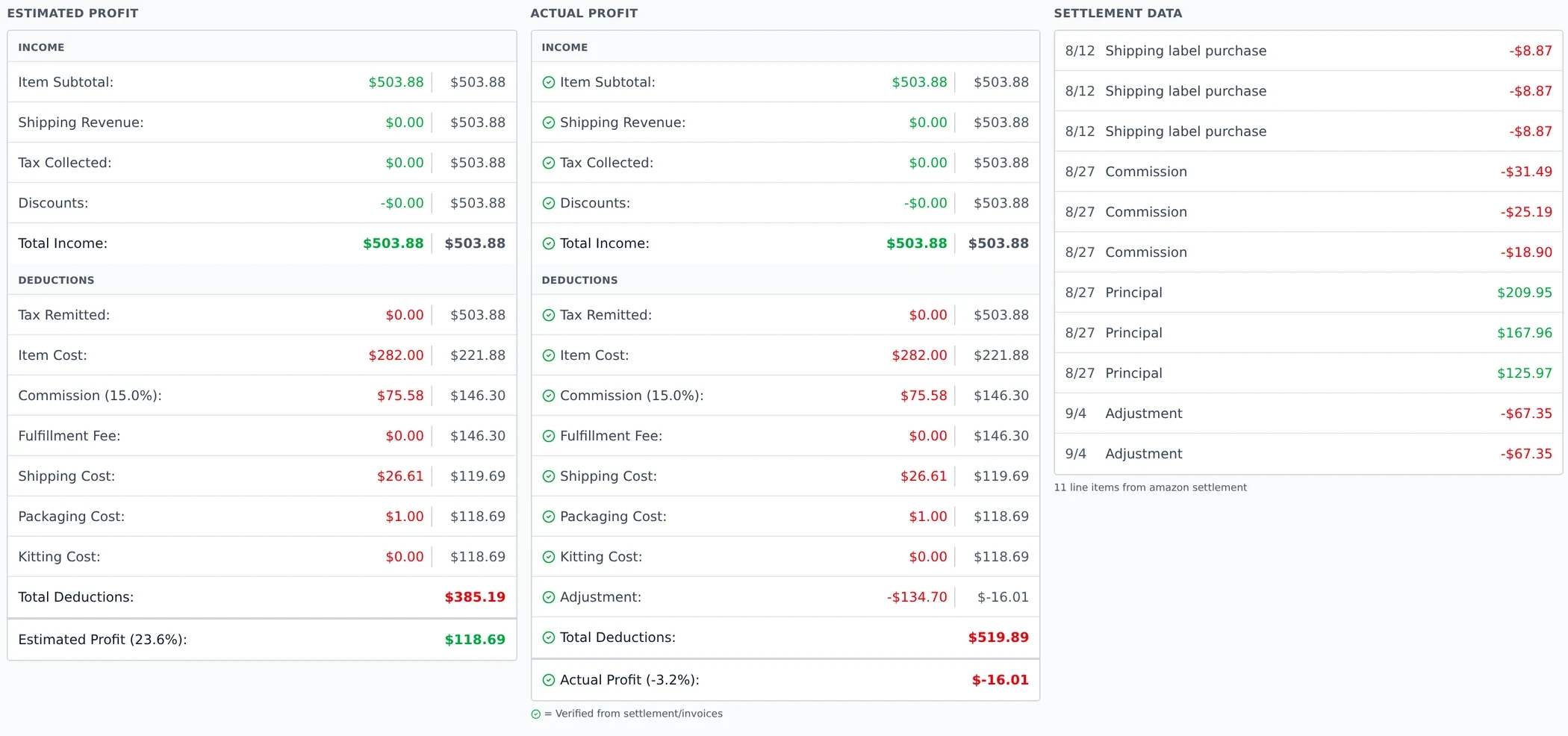
What the order looked like when it shipped
12 units, $503.88 in sales. The costs Rilk already had on the order:
- Cost of goods: $282.00, the unit cost of the 12 units
- Amazon commission (15%): $75.58
- Shipping: $26.61, three labels bought through Amazon at $8.87 each
- Packaging: $1.00
Estimated profit: $118.69. Most sellers would log that as a solid order and move on.
What the settlement said
Amazon paid the order out on 8/27: three principal payments and three commissions, matching the estimate to the cent. So far, so good.
Then on 9/4, two more lines landed on the same order: two adjustments of −$67.35. Amazon labels them just that, "Adjustment," without saying what they are. Dig into the detail and they're shipping adjustments: the carrier re-rated the labels bought through Amazon, after the fact. $26.61 of labels turned into $161.31 of shipping.
Actual profit: −$16.01, a −3.2% margin. The order lost money.
Why almost nobody catches this
The adjustments arrived a week after the payout, inside a settlement report full of lines from every other order, with a label that says nothing about what happened. Unless someone traces each settlement line back to the order it belongs to, that order stays a $119 winner in the books forever, and the seller keeps buying, pricing and shipping that product as if it were one.
And finding it is only half the problem. Whether you can get the money back depends on whose account the label was on. On labels bought through Amazon, you can open a Seller Support case with the tracking number and proof of the real weight and dimensions, though results vary. When the label is on your own carrier account connected to Amazon, the re-rate comes from the carrier and you dispute it with the carrier directly, through that carrier's own billing-adjustment process. Either way you need the list: which orders were re-rated, by how much, and which products, box sizes and lanes keep getting hit, so you can dispute what's disputable and fix the packaging or the price before the next hundred orders do the same thing.
That's the gap we wrote about in why estimated profit lies. Here is what it looks like on a single order.
How Rilk shows it
Every order in Rilk carries its own P&L, built from costs that were recorded when the work happened: the unit cost from the purchase order, the marketplace's fees, the label you bought, packaging, and returns if the order comes back. Nothing has to be entered by hand or estimated after the fact.
Then Rilk breaks the marketplace settlement into its individual lines and ties each one back to the order it belongs to. That's the right-hand column in the screenshot. When a line like that re-rate shows up a week later, it lands on this order and the actual profit updates. Every line with a check mark was verified against the settlement or the carrier's invoice, not estimated.
The same order-level numbers build the reports: margin and fees across channels, profit per purchase order, and payout reconciliation that matches each Amazon, Walmart and eBay payout to the orders it paid for. Every plan shows each order's revenue, marketplace fees and shipping. Item cost, and so true per-order profit, comes from purchase orders, which are on Pro and Ultimate, as are reports.
Start free at rilk.ai — no credit card required, and one 14-day Pro trial per account to see your own orders this way. See plans.
About the author
Nouri Shaaya
CEO, Rilk
Nouri Shaaya is the CEO of Rilk. He has been selling online since 2013, running a multi-channel operation across Amazon, Walmart, eBay and retail drop-ship, with sales approaching $40 million a year.
More from NouriReady to simplify your operations?
See how Rilk replaces your spreadsheets and duct-taped tool stack with one platform built by sellers, for sellers.